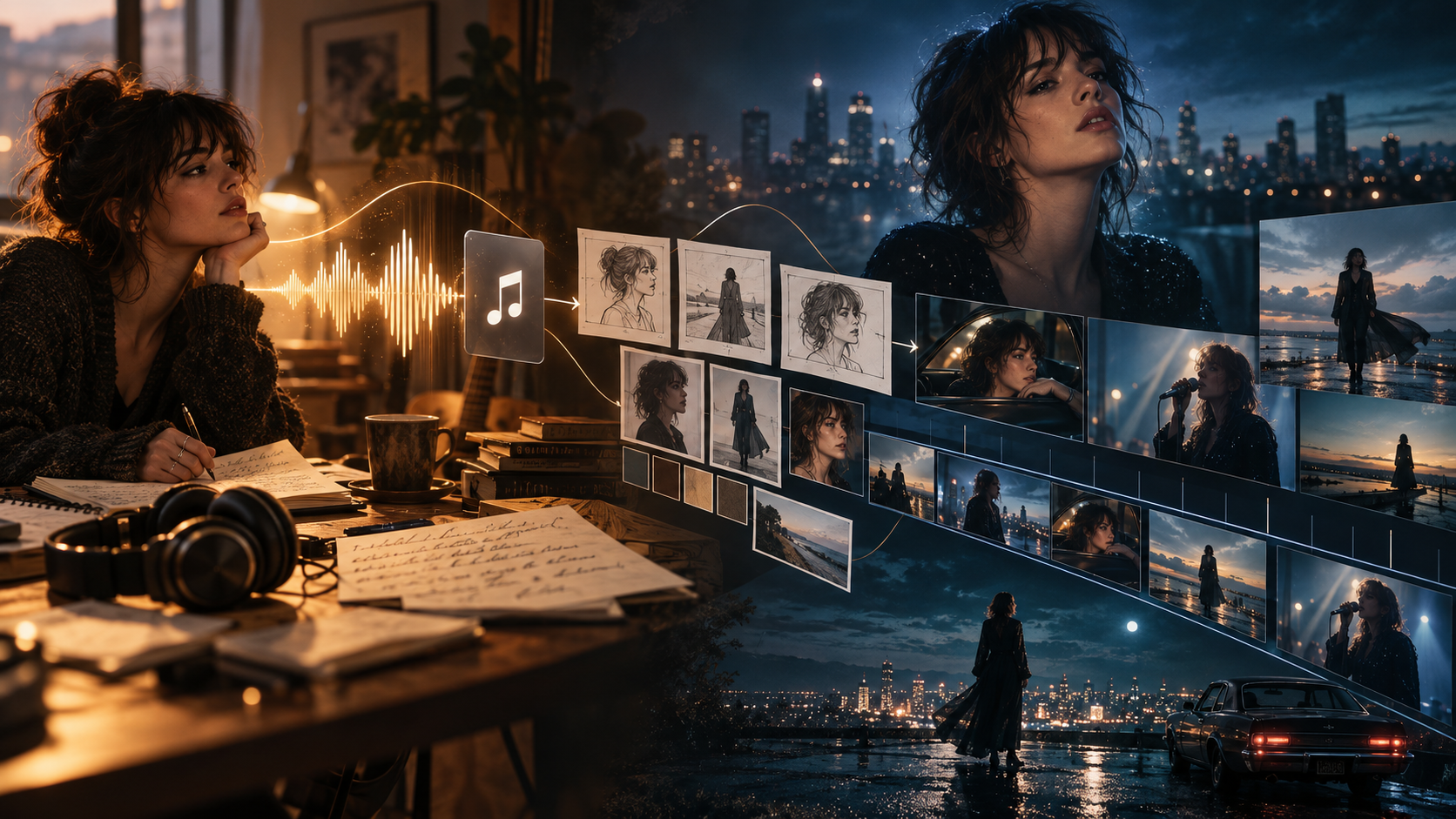
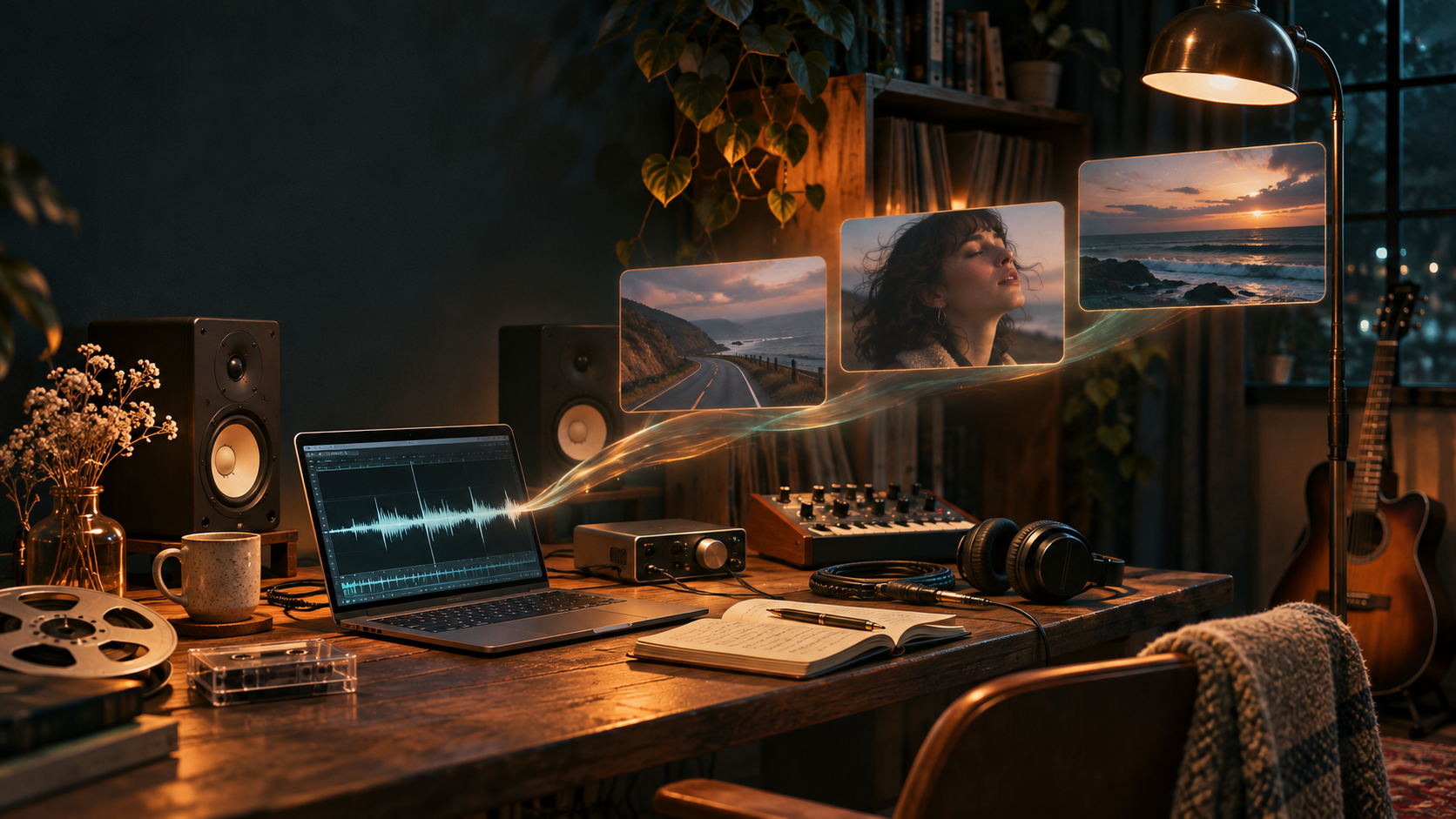
25 Suno Music Video Prompts: Storyboard Ideas for Finished AI Songs
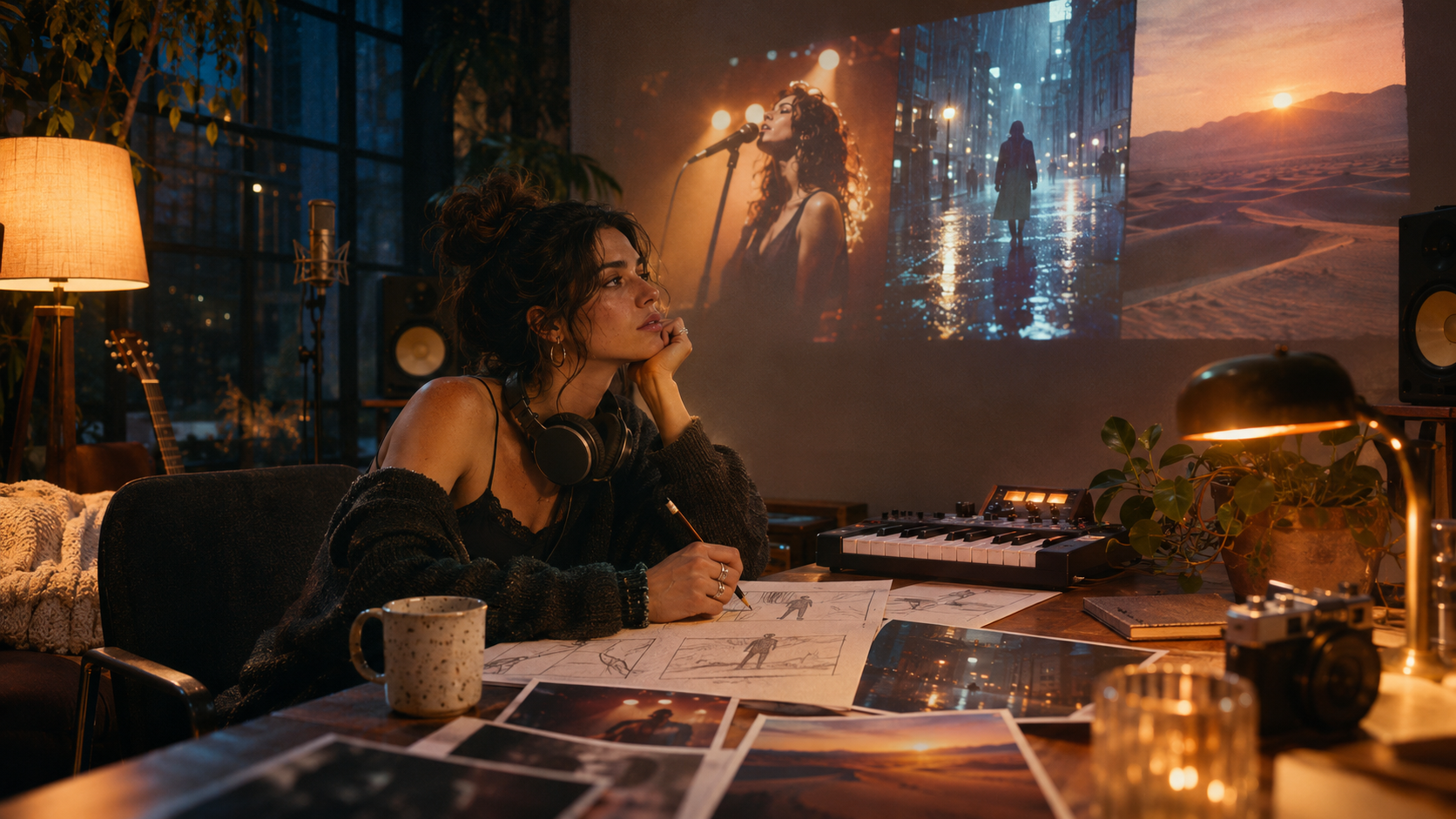
You've finished your song in Suno. The chorus sounds right, the vocals feel complete, and the track is ready to share.
But what should the music video actually look like?
A singer on a rooftop? A late-night train ride? A futuristic city? A full rock band performing under the sunset?
The hardest part isn't always generating the visuals. It's deciding what happens in them — and making those scenes feel like they belong to the same song.
That's where a good music video prompt makes a difference.
Below are 25 Suno music video prompts and storyboard ideas designed for finished AI songs. Each idea includes a visual concept, a copy-ready prompt, a five-part storyboard, and practical tips for turning the concept into a complete music video.
These aren't prompts for generating music inside Suno. They're prompts for creating the visuals that come after the song is finished.
Whether you're making pop, rock, R&B, hip-hop, EDM, or instrumental music, you can use these ideas as a starting point and adapt them to your own sound.
Already have your song ready? You can use a music video generator to turn one of these concepts into a full-length music video, rather than generating unrelated clips one by one.
How to Use These Suno Music Video Prompts
Before copying a prompt, it helps to understand the difference between a visual concept and a complete music video plan.
A prompt describes what you want to see. A storyboard determines when you want to see it.
Both matter when you're creating a video for an entire song.
Music Prompts vs. Music Video Prompts: Know the Difference
A Suno music prompt usually describes the audio you want to generate.
For example:
Melancholic indie pop, intimate female vocals, soft electric guitar, warm analog synthesizers, nostalgic atmosphere, and a gradually building chorus.
A music video prompt describes the visual world surrounding that song.
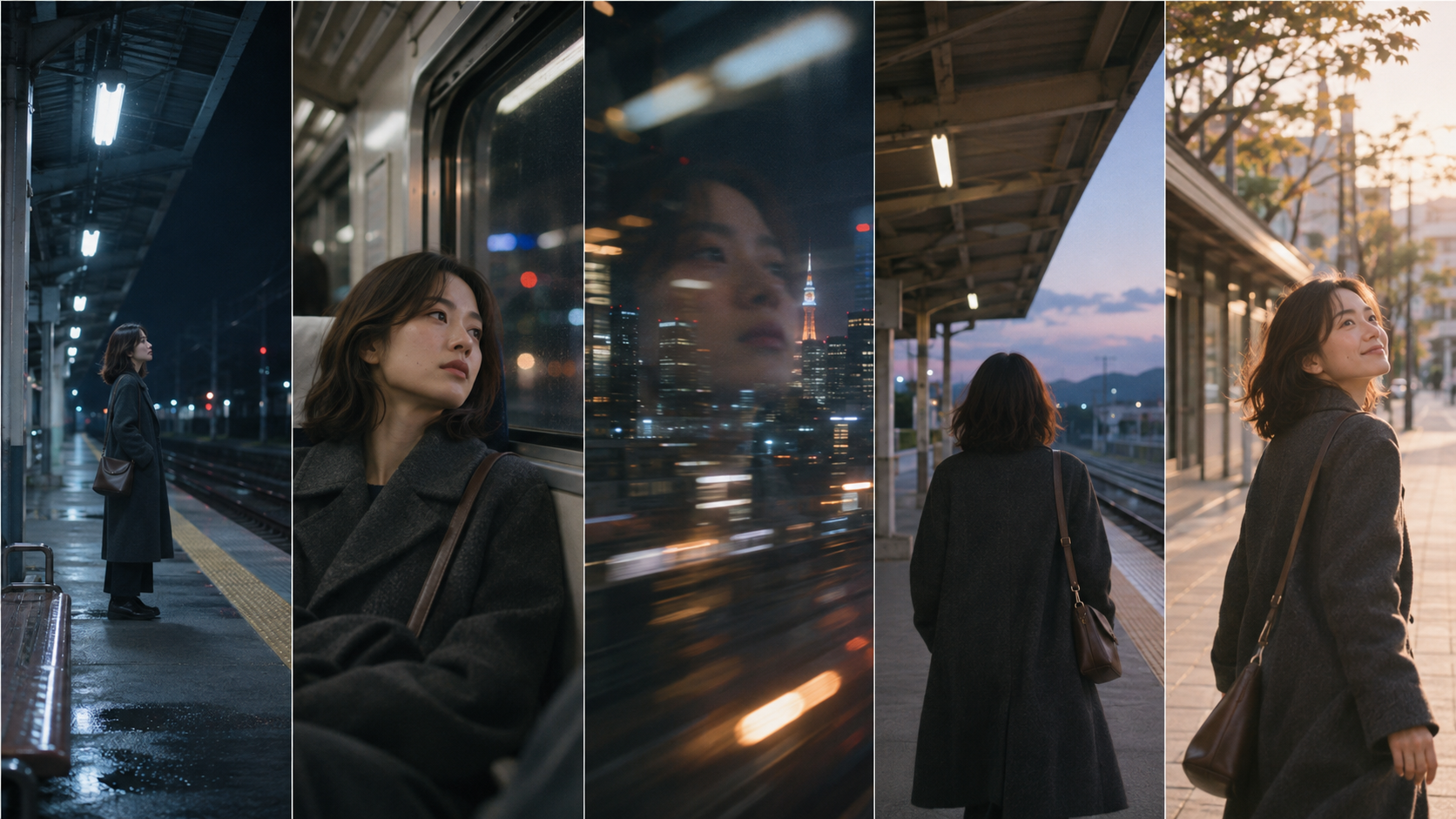
A young woman rides the last train through a sleeping city, watching blurred streetlights pass outside the window. Cinematic nighttime photography, natural facial expressions, cool blue interior lighting, subtle reflections, slow camera movement, and an atmosphere of unresolved nostalgia.
The first prompt tells Suno how the song should sound.
The second gives an AI video tool a visual direction.
If your song is already finished, you usually don't need another music-generation prompt. You need a way to translate its atmosphere, rhythm, lyrics, and emotional progression into images and motion.
For a complete walkthrough of the process, see our guide on how to create a music video with Suno AI.
The Five-Beat Storyboard: Intro, Verse, Chorus, Bridge, Outro
A complete music video needs more than one attractive scene.
Consider how a typical song develops:
| Song Section | Visual Purpose | Suggested Approach |
|---|---|---|
| Intro | Introduce the world | Establishing shots, atmosphere, visual mystery |
| Verse | Develop the character or story | Intimate moments, details, controlled movement |
| Chorus | Deliver the strongest visual moment | Performance, wider compositions, emotional release |
| Bridge | Introduce contrast or a turning point | New perspective, quieter scene, unexpected reveal |
| Outro | Complete the visual journey | Resolution, visual callback, memorable final shot |
This structure works for many types of music, but it isn't a rigid rule.
Some songs contain multiple verses, repeated choruses, instrumental breaks, or no traditional bridge.
Treat these five stages as storytelling functions. Repeat, shorten, or rearrange them to match your actual song.
A three-minute music video will also need more than five individual shots. Each stage can contain several clips with different camera angles and actions.
What to Customize Before Copying a Prompt
Most good AI music video prompts contain seven useful elements:
Subject + Action + Location + Mood + Camera + Lighting + Visual Style
You can also add constraints to prevent unwanted results.
For example, instead of writing:
A singer performing a beautiful song at night.
Try:
A female indie-pop singer performs alone on a quiet rooftop overlooking the city at night. She wears a simple black satin dress, with natural makeup and softly windblown hair. The camera slowly moves from a medium shot into a close-up during an emotional vocal line. Warm city lights glow in the background, with subtle 35mm film grain, realistic skin texture, and restrained cinematic lighting. Preserve the same face, hairstyle, and outfit throughout the performance.
The second version gives the model clearer decisions about the subject, environment, framing, and visual style.
Before using any of the following prompts, adjust the character description, location, mood, and visual style to fit your song.
If your video features a recurring artist, use a consistent character reference whenever your chosen tool supports one.
Most importantly, don't force every scene to show someone singing. Instrumental sections, narrative moments, and environmental shots can be just as important as performance footage.
25 Suno Music Video Prompts and Storyboard Ideas
The following Suno AI music video ideas are organized into five creative categories:
- •Performance-driven music videos
- •Story-driven music videos
- •Cinematic and fantasy concepts
- •Artistic and experimental visuals
- •Genre-specific music video ideas
Each prompt can be adapted for a full song or a shorter promotional video.
The five-part storyboards are creative starting points, not fixed clip timings. Use your finished track to determine the actual scene lengths, transitions, and pacing.
Performance-Driven Suno Music Video Ideas
Performance videos are especially useful when the artist's identity, vocals, or stage presence should be the center of attention.
The key is to create visual progression rather than repeating the same singing close-up for an entire song.
1. The Rooftop Pop Confession
Best for: Emotional pop, indie pop, synth-pop
Visual concept: A singer begins an intimate performance on an empty rooftop. As the song becomes more emotional, the city gradually transforms into a glowing backdrop. The video moves from private confession to public release without leaving its main location.
Copy-Paste Music Video Prompt
Create a cinematic pop music video featuring a young female singer performing on a quiet rooftop overlooking a modern city at blue hour. She wears an elegant, understated outfit with natural makeup and realistic skin texture. Begin with intimate medium shots and subtle facial expressions, then gradually expand into wider performance shots as the music grows. The wind moves her hair naturally while distant city lights appear behind her. Use realistic cinematography, soft blue ambient light, warm practical highlights, graceful camera movement, and subtle 35mm film grain. Keep the singer's facial features, clothing, and hairstyle consistent. Avoid exaggerated acting, artificial beauty filters, and excessive camera effects.
Five-Beat Storyboard
- •Intro: The camera slowly approaches an empty rooftop. The singer stands near the edge, facing the city.
- •Verse: She begins performing quietly, with intimate close-ups and restrained gestures.
- •Chorus: A wide camera movement reveals the illuminated skyline as her performance becomes more expressive.
- •Bridge: She stops singing and looks toward the distant horizon while the instrumental continues.
- •Outro: The camera pulls back, leaving her silhouette against the city lights.
Practical tip: Reserve close-up lip-sync shots for the strongest vocal moments. Use wide shots and city details to create breathing room between performances.
2. One Song, One Rock Band
Best for: Alternative rock, pop rock, indie rock
Visual concept: A rock band starts in a small rehearsal room and gradually moves into a powerful outdoor performance. The musicians remain recognizable throughout, creating the feeling of a real band rather than a collection of disconnected AI characters.
Copy-Paste Music Video Prompt
A cinematic live-performance music video featuring a four-member alternative rock band with one female lead vocalist, one guitarist, one bassist, and one drummer. The band begins playing inside a modest rehearsal studio filled with authentic instruments and natural window light. As the song builds, the performance transitions to an open outdoor stage at sunset. Capture believable instrument-playing gestures, expressive but controlled movements, realistic stage lighting, and documentary-style camera angles. Alternate between close-ups of the vocalist, medium shots of individual musicians, and wide shots of the complete band. Preserve each musician's identity, instruments, clothing, and physical proportions. Natural skin texture, cinematic film grain, no distorted hands or extra band members.
Five-Beat Storyboard
- •Intro: Guitar and drum details establish the rehearsal space before the vocalist enters.
- •Verse: The singer performs in the studio while other musicians prepare the song's energy.
- •Chorus: Cut to the full band performing together on an outdoor stage.
- •Bridge: Intimate musician close-ups and a quieter backstage moment interrupt the performance.
- •Outro: The final chorus expands into a wide sunset performance before the stage falls quiet.
Practical tip: Create a clear reference for every recurring band member. Keep the lead vocalist in front-facing shots when lip sync is important, and use instrument or wide shots when it isn't.
3. The Midnight R&B Lounge
Best for: R&B, soul, jazz-pop, slow jams
Visual concept: A singer performs in a sophisticated late-night lounge where the emotional story is communicated through reflections, gestures, and the space between people.
Copy-Paste Music Video Prompt
Create an intimate cinematic R&B music video set inside an elegant, nearly empty lounge after midnight. A soulful female singer performs beside a vintage microphone, wearing a refined burgundy satin outfit and subtle natural makeup. Warm amber table lamps illuminate polished wood, velvet seating, and delicate reflections on glass. Use slow dolly movements, intimate portraits, over-the-shoulder compositions, and carefully framed negative space. The singer's performance should feel vulnerable and natural rather than theatrical. Occasionally reveal an empty table and a second untouched drink, suggesting someone is missing. Realistic human anatomy, detailed skin texture, shallow depth of field, authentic vintage-lens character, and consistent wardrobe throughout.
Five-Beat Storyboard
- •Intro: The camera glides past empty tables toward the small stage.
- •Verse: The singer begins a restrained performance, occasionally looking toward an empty seat.
- •Chorus: Close-ups become more direct as the singer confronts the emotion behind the lyrics.
- •Bridge: The performance pauses visually while the camera explores the abandoned table and surrounding room.
- •Outro: The singer leaves the microphone as the last table lamp fades.
Practical tip: R&B visuals often benefit from expressive close-ups, but don't fill every second with them. Empty space can communicate absence more effectively than elaborate effects.
4. Two Sides of the Same Rapper
Best for: Hip-hop, melodic rap, conscious rap
Visual concept: One artist appears in two contrasting worlds: the life they show others and the private reality they rarely reveal.
Copy-Paste Music Video Prompt
A visually striking hip-hop music video featuring the same male rapper in two contrasting environments. In the first, he performs confidently on a minimalist rooftop surrounded by clean architecture and bright daylight. In the second, he sits alone in a small apartment late at night, surrounded by unfinished notebooks, ordinary furniture, and quiet city reflections. Use match cuts to transition between both versions of his life while preserving identical facial features. Daytime scenes have precise symmetrical framing and bold natural contrast; nighttime scenes feel handheld, intimate, and imperfect. Natural performance gestures, authentic streetwear, realistic skin texture, controlled camera movements, and cinematic color grading. Avoid duplicated faces within a single shot and exaggerated luxury imagery.
Five-Beat Storyboard
- •Intro: Two environments appear through matching camera compositions.
- •Verse: The rapper performs confidently in daylight.
- •Chorus: Rapid but controlled cross-cutting contrasts public performance with private life.
- •Bridge: The camera remains in the apartment as the artist reflects silently.
- •Outro: Both visual worlds merge through one final matching composition.
Practical tip: Keep the same face and hairstyle in both worlds. Use lighting, wardrobe, location, and camera language to express the contrast.
5. The Sunset Dance Performance
Best for: Dance-pop, upbeat pop, disco-inspired music
Visual concept: A choreographed performance evolves from an intimate solo into a joyful group routine as the sun sets.
Copy-Paste Music Video Prompt
A premium dance-pop music video filmed on an open terrace overlooking the ocean during golden hour. One charismatic female performer begins a controlled contemporary-pop dance routine, gradually joined by a small group of backup dancers. Elegant modern styling, natural skin texture, tasteful costumes, and believable choreography. The camera alternates between full-body wide shots that clearly show the choreography, medium performance angles, and occasional close-ups during vocal phrases. Warm sunlight creates long shadows across textured stone flooring. As the song progresses, subtle practical lighting becomes visible around the terrace. Keep dancers' positions spatially consistent, preserve realistic body proportions, and avoid excessive spins, impossible movements, duplicated people, or unnatural limbs.
Five-Beat Storyboard
- •Intro: The lead performer stands alone as the sun approaches the horizon.
- •Verse: A controlled solo introduces the movement language.
- •Chorus: Backup dancers join in a wider synchronized formation.
- •Bridge: The music becomes more intimate, returning to a solo silhouette.
- •Outro: The group performs a final formation as the sky turns blue.
Practical tip: Use full-body views for complex choreography. Avoid asking the AI to perform too many unrelated dance movements in a single short clip.
Story-Driven Music Video Prompts
Some songs work better as short films than stage performances.
Instead of illustrating every lyric literally, these concepts follow a character through a recognizable emotional journey.
6. The Last Train Home
Best for: Indie pop, emotional ballads, alternative pop
Visual concept: A solitary train journey becomes a story about memory, separation, and moving forward.
Copy-Paste Music Video Prompt
Create a cinematic narrative music video following a young woman traveling alone on the last train through a sleeping city. She wears a charcoal coat and carries a worn leather shoulder bag. Begin at an almost empty station beneath cool fluorescent lights, then move into quiet train interiors filled with reflections of passing city lights. Show intimate gestures, distant expressions, and subtle visual memories suggested through matching compositions rather than literal flashback effects. The atmosphere gradually transitions from midnight blue to pale early-morning light. Use natural human movement, believable train interiors, restrained 35mm film photography, and consistent character appearance. Avoid dramatic crying, excessive slow motion, and unrealistic reflections.
Five-Beat Storyboard
- •Intro: A nearly empty station. The woman waits beside the final arriving train.
- •Verse: She sits by the window, watching familiar places disappear.
- •Chorus: Passing lights and fragmented visual memories create a sense of emotional movement.
- •Bridge: She steps onto an unfamiliar platform just before dawn.
- •Outro: The camera follows her into the first morning light.
Practical tip: This concept works well without continuous lip sync. Let facial expressions, movement, and environmental details communicate the song's emotion.
7. Postcards From a Lost Summer
Best for: Nostalgic pop, bedroom pop, indie folk
Visual concept: A musician revisits a summer through faded photographs, old locations, and memories that no longer match the present.
Copy-Paste Music Video Prompt
A nostalgic music video built around the visual contrast between present-day life and memories of one unforgettable summer. Follow a young woman as she discovers a collection of old photographs in her apartment. Each photograph introduces a warm cinematic memory: riding bicycles near the sea, running through tall grass, sitting beside a quiet swimming pool, and watching fireworks from a distant hill. Use two distinct visual textures: natural, slightly desaturated 35mm photography for the present and gently faded Super 8 film for the memories. Keep recurring characters recognizable across time. Authentic everyday clothing, spontaneous expressions, subtle camera imperfections, soft summer light, and no artificial-looking retro overlays.
Five-Beat Storyboard
- •Intro: A photograph falls from an old notebook.
- •Verse: The protagonist revisits ordinary places connected to the past.
- •Chorus: Warm summer memories fill the screen with movement and sunlight.
- •Bridge: She returns to one location and finds it changed.
- •Outro: She places a new photograph beside the old ones.
Practical tip: Use the same recurring visual object — a photograph, bracelet, or bicycle — to connect separate scenes without needing complicated transitions.
8. The Road Trip That Changed Everything
Best for: Country, folk rock, Americana
Visual concept: A journey across rural landscapes reveals that the protagonist is returning to something important rather than simply escaping.
Copy-Paste Music Video Prompt
A grounded cinematic country music video following a man driving an older pickup truck through rural American landscapes. Dusty backroads, quiet gas stations, open fields, weathered farmhouses, and early-morning highways establish a sense of real distance traveled. The protagonist wears simple denim clothing and carries a small cardboard box containing meaningful personal belongings. Use authentic natural light, restrained handheld cinematography, wide landscape compositions, and intimate details of hands, road signs, and passing scenery. The story should feel personal and lived-in rather than like a glossy car advertisement. Preserve the same vehicle, character, and clothing. Avoid unrealistic driving scenes, sudden location changes, and exaggerated emotional acting.
Five-Beat Storyboard
- •Intro: The protagonist packs a small box and starts the truck.
- •Verse: Quiet roadside moments reveal the distance of the journey.
- •Chorus: Wide landscape shots open the world as the music grows.
- •Bridge: He arrives outside a familiar farmhouse but hesitates before approaching.
- •Outro: The box is placed on the porch as someone opens the door.
Practical tip: A recurring object creates narrative purpose. The audience doesn't need every detail explained if the ending gives the journey meaning.
9. A Voicemail Never Sent
Best for: Piano ballads, acoustic pop, emotional R&B
Visual concept: A person repeatedly tries to say something important but never sends the message. The music video follows the ordinary moments surrounding that decision.
Copy-Paste Music Video Prompt
Create an intimate cinematic music video about a young woman struggling to record a personal voice message she never sends. The story unfolds in a modest apartment, on a quiet street, inside a neighborhood café, and beside an open window at night. Show her holding a phone, hesitating, putting it away, and moving through everyday routines while emotionally distracted. Avoid readable phone interfaces and unnecessary screen graphics. Use realistic indoor lighting, natural makeup, understated wardrobe, restrained camera movements, soft close-ups, and authentic human expressions. The emotional tone is vulnerable but never melodramatic. Maintain the same character appearance and use recurring compositions to convey her hesitation.
Five-Beat Storyboard
- •Intro: A phone rests on a table beside an unfinished cup of tea.
- •Verse: She begins recording a message but stops.
- •Chorus: Scenes from daily life reveal how the unsent words remain with her.
- •Bridge: She finally holds the phone close and speaks with quiet confidence.
- •Outro: She puts it down and walks outside, leaving the outcome open.
Practical tip: Avoid generating legible text on phone screens. If the story needs readable words, add them separately during editing.
10. The Diner at the End of the Night
Best for: Alternative soul, indie rock, cinematic pop
Visual concept: A late-night diner becomes the meeting point for several people whose separate experiences quietly connect.
Copy-Paste Music Video Prompt
An atmospheric narrative music video taking place inside a small roadside diner shortly before sunrise. Follow a tired waitress through a series of understated encounters with the same three customers: a traveler carrying a suitcase, an older man quietly reading, and a young woman sitting alone beside the window. Each character has a distinct visual identity and consistent clothing. The diner features worn red booths, warm tungsten lighting, rain-streaked windows, stainless steel counters, and ordinary objects with believable texture. Use carefully composed observational shots, natural performances, slow tracking movements, and subtle emotional storytelling. Avoid exaggerated facial expressions, artificial neon overload, or crowded backgrounds that distract from the characters.
Five-Beat Storyboard
- •Intro: Exterior of the diner on a quiet road.
- •Verse: The waitress serves the three customers through small, ordinary interactions.
- •Chorus: Cross-cutting reveals the different emotional states within the same room.
- •Bridge: One customer leaves behind an unexpected personal object.
- •Outro: The diner opens to daylight while the waitress watches the road.
Practical tip: Keep the cast small. Three recognizable supporting characters can create a stronger story than a large crowd with inconsistent faces.
Cinematic and Fantasy Music Video Storyboards
Cinematic AI music video prompts are especially effective when a song suggests a world larger than everyday reality.
The challenge is giving that world visual rules so the scenes remain connected.
11. Neon City, No Way Home
Best for: Synthwave, dark electronic, cinematic pop
Visual concept: A lone traveler navigates a futuristic city where every familiar route seems to lead back to the same place.
Copy-Paste Music Video Prompt
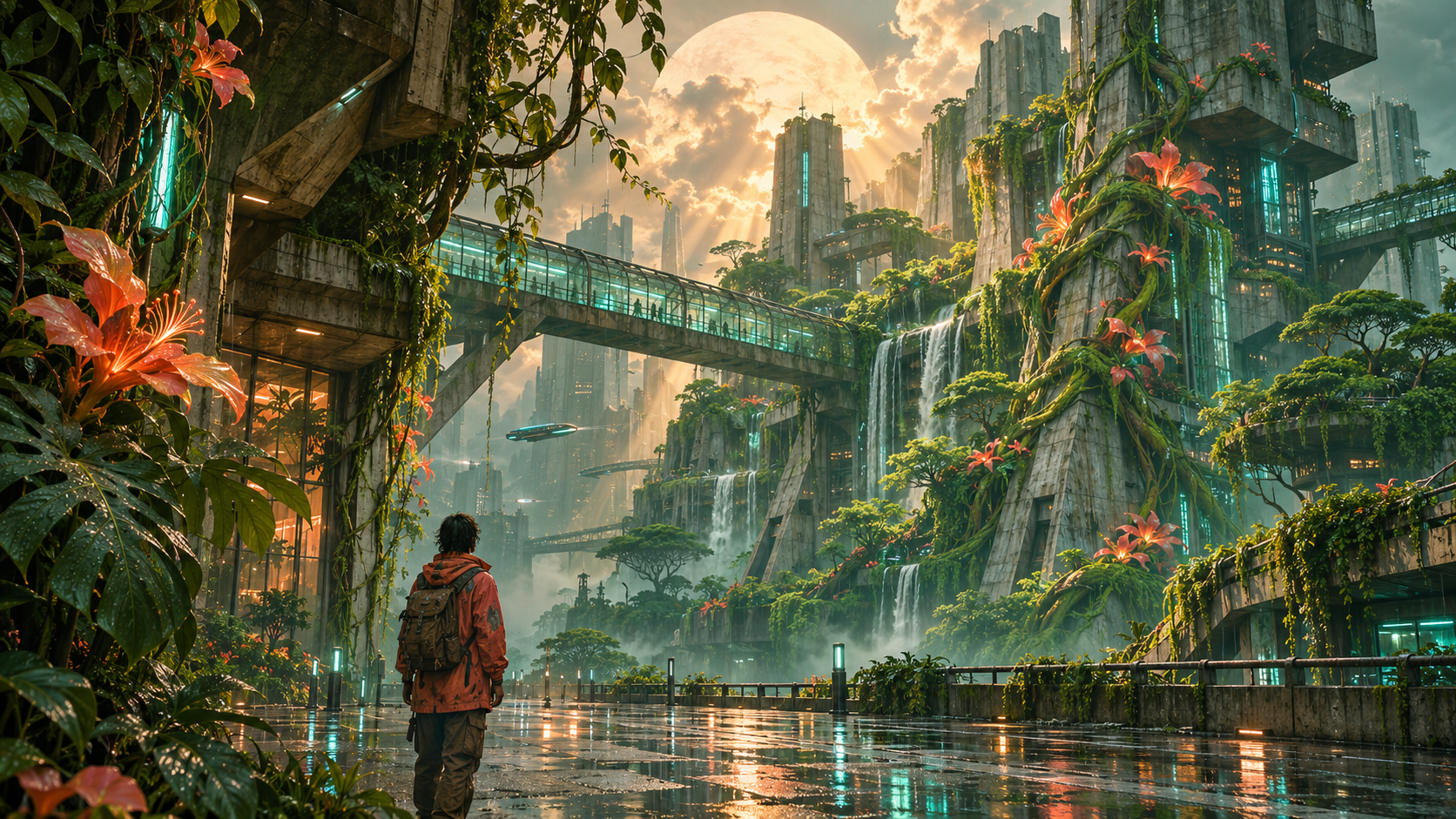
Create a moody science-fiction music video set in a vast futuristic city after midnight. A solitary woman wearing a distinctive dark red coat walks through rain-soaked streets, elevated pedestrian bridges, and quiet underground transit stations. The architecture combines brutalist concrete, reflective glass, and restrained neon lighting. Emphasize emotional isolation rather than action spectacle. Use wide anamorphic compositions, slow tracking shots, realistic rain reflections, atmospheric haze, and a controlled palette of deep blue, muted violet, and occasional red highlights. The same character must remain recognizable in every location. Maintain plausible urban geography and natural walking movement. Avoid crowded holographic advertisements, unreadable floating text, and excessive cyberpunk clichés.
Five-Beat Storyboard
- •Intro: A deserted city intersection establishes the environment.
- •Verse: The protagonist searches for a way through unfamiliar streets.
- •Chorus: Wide architectural shots reveal the overwhelming scale of the city.
- •Bridge: She recognizes the same location she passed earlier.
- •Outro: She stops running and looks toward the first sign of daylight.
Practical tip: Reuse a small number of distinctive locations. Returning to the same place can make the world feel more intentional.
12. The Last Light in the Desert
Best for: Cinematic orchestral music, epic ballads, ambient rock
Visual concept: A traveler crosses an immense desert toward a distant light that may or may not be real.
Copy-Paste Music Video Prompt
An epic yet emotionally restrained cinematic music video following a lone traveler crossing a vast desert landscape. The traveler wears a weathered sand-colored cloak and carries a small lantern. Monumental dunes, distant rock formations, drifting sand, and enormous open skies establish a feeling of isolation and determination. Begin in cool pre-dawn light and gradually introduce warm sunlight as the journey progresses. Use carefully composed extreme wide shots, occasional intimate details of footsteps and fabric, slow aerial perspectives, and physically believable environmental movement. The visual language should resemble an atmospheric adventure film rather than a fantasy video game. Maintain consistent costume details, realistic human scale, and natural landscape lighting.
Five-Beat Storyboard
- •Intro: A tiny human figure walks across an enormous dune.
- •Verse: The lantern becomes a recurring visual anchor.
- •Chorus: Expansive landscape shots reveal the scale of the journey.
- •Bridge: A sandstorm briefly obscures the distant light.
- •Outro: The traveler reaches a ridge where sunlight reveals the landscape beyond.
Practical tip: Instrumental music can carry a narrative through scale, composition, and changing light without needing a singing character.
13. When the Forest Takes Over
Best for: Dark pop, alternative rock, experimental electronic
Visual concept: Nature slowly reclaims a modern city as one person witnesses the transformation.
Copy-Paste Music Video Prompt
A surreal cinematic music video set in a contemporary city gradually being overtaken by plants and trees. Follow one female protagonist in a simple black coat as she moves through an ordinary apartment, a quiet office corridor, an empty street, and a large public plaza. At first, only a few leaves appear in unexpected places. As the song builds, roots emerge through concrete cracks, vines spread across windows, and enormous trees rise between buildings. Use realistic environmental textures, natural human movement, physically convincing vegetation, controlled wide shots, and gentle camera tracking. The atmosphere should feel mysterious and strangely beautiful rather than frightening. Maintain the same protagonist and consistent architecture across the transformation.
Five-Beat Storyboard
- •Intro: A small green shoot appears in a crack beside a window.
- •Verse: The protagonist notices subtle changes around familiar places.
- •Chorus: Streets and buildings become increasingly covered by vegetation.
- •Bridge: She enters a silent, abandoned public square transformed into a garden.
- •Outro: A wide shot reveals the city integrated with an immense forest.
Practical tip: Introduce the transformation gradually. A clear visual progression creates more impact than beginning with the largest spectacle.
14. The Underwater Ballroom
Best for: Dream pop, ethereal vocals, ambient pop
Visual concept: A forgotten ballroom exists beneath the surface of an impossible ocean, where memory and movement seem suspended in time.
Copy-Paste Music Video Prompt
Create a poetic surreal music video inside a grand abandoned ballroom submerged beneath clear blue water. Elegant architectural columns, aged chandeliers, long curtains, and delicate particles float slowly in the environment. A woman in a flowing ivory dress moves gracefully through the ballroom, as if the water carries her movements. The scene should feel dreamlike but visually sophisticated, with believable fabric movement, soft underwater sunlight, atmospheric depth, and restrained color grading. Use slow symmetrical camera movements, wide architectural shots, and intimate details of the protagonist's hands and expression. Keep the same woman and dress throughout. Avoid exaggerated swimming motions, cartoon effects, distorted anatomy, or overly saturated fantasy colors.
Five-Beat Storyboard
- •Intro: Sunlight filters into the empty submerged ballroom.
- •Verse: The protagonist enters and begins moving through the space.
- •Chorus: Curtains and fabric drift as the room becomes a surreal dance environment.
- •Bridge: She discovers an untouched object connected to a forgotten memory.
- •Outro: The camera rises toward the water's surface as light fills the room.
Practical tip: For surreal environments, maintain consistent lighting and architectural details. The world can be impossible while still feeling visually coherent.
15. Signals From Another World
Best for: Electronic music, ambient, cinematic synth, experimental pop
Visual concept: A researcher receives a mysterious signal and follows it into a landscape that seems to exist between Earth and another world.
Copy-Paste Music Video Prompt
A contemplative science-fiction music video following a solitary researcher investigating an unexplained signal at a remote listening station. Begin inside a realistic control room filled with analog equipment, weathered metal surfaces, and soft instrument lights. The researcher travels into a vast icy landscape beneath a dramatic twilight sky, discovering subtle geometric structures emerging from the snow. Use restrained futuristic design, wide cinematic landscapes, natural atmospheric lighting, practical-looking equipment, and slow controlled camera movement. The visual mystery should unfold gradually rather than relying on battles or explosions. Preserve the character's dark insulated clothing, equipment, and recognizable silhouette. Cool cyan and slate-blue tones contrast with occasional warm signal lights.
Five-Beat Storyboard
- •Intro: A quiet listening station receives an unfamiliar signal.
- •Verse: The researcher traces the transmission beyond the station.
- •Chorus: The icy landscape reveals strange geometric formations.
- •Bridge: The signal leads to a silent structure beneath the snow.
- •Outro: A distant light answers from the horizon as the researcher watches.
Practical tip: Avoid explaining the entire mystery. Leaving one powerful visual question unanswered can make the ending more memorable.
Artistic and Experimental AI Music Video Ideas
Not every music video needs realistic actors or traditional cinematic photography.
Animation, mixed media, and experimental visuals can give an AI-generated song a distinctive visual identity.
16. A World Made of Paper
Best for: Indie folk, acoustic pop, whimsical electronic
Visual concept: An entire world is constructed from handmade paper, following one tiny character through a changing landscape.
Copy-Paste Music Video Prompt
A handcrafted stop-motion music video created entirely from layered cut paper, painted cardstock, folded paper structures, and miniature physical props. Follow a small character wearing a terracotta-orange coat through a whimsical landscape of paper forests, winding rivers, tiny houses, and oversized flowers. Every surface should reveal visible paper fibers, imperfect hand-cut edges, and realistic shadows between layered materials. Use warm studio lighting, carefully staged compositions, miniature set photography, and tactile stop-motion movement. The world should feel playful, imaginative, and lovingly handmade rather than digitally polished. Maintain the same character design and physical materials throughout. Avoid glossy CGI, smooth plastic textures, artificial 3D animation, and readable text.
Five-Beat Storyboard
- •Intro: A small paper character emerges from a folded paper house.
- •Verse: The character explores a colorful handmade forest.
- •Chorus: Paper landscapes unfold and transform around the character.
- •Bridge: The world briefly collapses into flat sheets of paper.
- •Outro: The character rebuilds a small home within the transformed landscape.
Practical tip: Use the same material language throughout the video. Even wildly different environments can feel connected when they share a consistent handmade texture.

17. The Analog Video Diary
Best for: Bedroom pop, indie rock, nostalgic alternative music
Visual concept: A collection of imperfect home-video memories gradually forms a personal story.
Copy-Paste Music Video Prompt
A deeply nostalgic music video designed to look like authentic home-video footage recorded on consumer camcorders during the late 1990s and early 2000s. Show ordinary intimate moments: friends sitting on an apartment floor, a quiet birthday celebration, a rainy afternoon seen from a bus window, late-night convenience store visits, and someone playing guitar in a bedroom. Use handheld framing, subtle tape noise, practical exposure shifts, natural faces, imperfect focus, and realistic analog video texture. Avoid polished studio compositions and exaggerated VHS distortion. The imagery should feel spontaneous, warm, and emotionally specific. Recurring characters must maintain consistent appearances across the video.
Five-Beat Storyboard
- •Intro: A camcorder starts recording an ordinary living room.
- •Verse: Small everyday moments introduce the recurring characters.
- •Chorus: Rapid memory fragments bring energy to the song.
- •Bridge: One longer, quieter recording interrupts the montage.
- •Outro: The camera is placed down while life continues beyond the frame.
Practical tip: Imperfection is part of the visual language. Don't overcorrect every handheld movement or exposure change.
18. Painted Through Four Seasons
Best for: Acoustic ballads, orchestral pop, emotional instrumentals
Visual concept: The same character moves through four seasons as if traveling through a series of living watercolor paintings.
Copy-Paste Music Video Prompt
A poetic animated music video rendered as delicate hand-painted watercolor illustrations on textured cotton paper. Follow one recognizable character through spring blossoms, bright summer fields, golden autumn streets, and a quiet winter landscape. Each scene features visible watercolor pigment blooms, gentle brush transitions, hand-painted architectural details, and subtle movement within the artwork. The character retains a consistent silhouette, hairstyle, and clothing design adapted only slightly for the seasons. Use restrained animation, natural compositions, soft atmospheric perspective, and carefully controlled color transitions. The visual style should feel like a sophisticated illustrated short film, not generic digital fantasy art. Avoid sharp 3D textures, plastic shading, and inconsistent facial proportions.
Five-Beat Storyboard
- •Intro: A blank paper surface gradually reveals the character in spring.
- •Verse: Gentle summer scenes communicate warmth and possibility.
- •Chorus: Autumn colors expand as the emotional intensity increases.
- •Bridge: Winter introduces stillness and a more reflective atmosphere.
- •Outro: New spring details appear in the final composition.
Practical tip: Use repeated composition and silhouette to preserve character identity even when the animation style is painterly.
19. One Room, Four Realities
Best for: Art pop, experimental electronic, alternative R&B
Visual concept: A single room transforms into four different realities while the central performer remains in the same position.
Copy-Paste Music Video Prompt
An experimental art-pop music video set entirely inside one carefully designed room. A single female performer stands near the center of the space, maintaining a consistent face, hairstyle, and silhouette while the environment transforms around her. Begin with a minimalist sunlit apartment, transition into a theatrical red-lit room, then a monochrome sculptural environment, and finally a dreamlike room filled with soft floating fabric. Maintain consistent room geometry and recognizable camera positions so each transformation feels connected. Use symmetrical framing, controlled slow camera movements, striking production design, realistic skin texture, and deliberate color contrast. Avoid abrupt character changes, impossible body movement, or distracting random effects.
Five-Beat Storyboard
- •Intro: The performer sits in a simple room with natural daylight.
- •Verse: The environment subtly changes through lighting and objects.
- •Chorus: Strong red lighting transforms the room into a theatrical performance space.
- •Bridge: The scene becomes almost monochrome, emphasizing isolation.
- •Outro: The original room returns, but one visual detail remains changed.
Practical tip: Keep the camera framing consistent during major environmental transformations. The contrast will feel more intentional.
20. Dancing With Your Shadow
Best for: Experimental pop, alternative dance, dark electronic
Visual concept: A performer's shadow gradually develops a movement language of its own, representing an internal struggle.
Copy-Paste Music Video Prompt
A minimalist experimental music video featuring one contemporary dancer performing inside a vast architectural studio with a single directional light source. The dancer wears a simple dark outfit and moves through restrained, expressive choreography. Her shadow initially follows her naturally across the wall and floor, then begins to shift independently in subtle ways, creating the impression of a second emotional presence. Use clean graphic compositions, strong contrast, realistic human anatomy, believable physical movement, and carefully controlled shadows. Alternate between wide full-body shots and intimate details of feet, hands, and fabric. The atmosphere should feel elegant and psychologically compelling, not supernatural horror. Avoid impossible limb movement and multiple distorted shadow figures.
Five-Beat Storyboard
- •Intro: A dancer stands alone beneath one directional light.
- •Verse: Slow movements create long, expressive shadows.
- •Chorus: The shadow begins moving differently from the dancer.
- •Bridge: Both figures pause in an unresolved visual confrontation.
- •Outro: Their movements return to alignment as the light softens.
Practical tip: Generate simple movement phrases rather than complex choreography involving repeated body transformations.
Genre-Specific Suno Music Video Prompts
Some music styles benefit from a particularly recognizable visual language.
The following concepts are designed around the way different genres use rhythm, texture, atmosphere, and performance.
21. The Rainy Lo-Fi Studio
Best for: Lo-fi hip-hop, chill beats, instrumental study music
Visual concept: An intimate bedroom studio becomes a quiet visual companion to the music.
Copy-Paste Music Video Prompt
A calming atmospheric music video set inside a small home music studio during a rainy evening. A young musician sits at a wooden desk beside a window, surrounded by headphones, a compact keyboard, notebooks, indoor plants, and a warm desk lamp. Raindrops slowly move across the window as distant city lights blur into soft reflections. Use gentle camera movements, intimate details of ordinary objects, natural shadow transitions, and restrained cinematic framing. The atmosphere should feel lived-in, peaceful, and quietly productive. Maintain a consistent room layout, realistic lighting, and authentic materials. Muted green, warm amber, and soft gray tones. Avoid exaggerated animation, visual clutter, bright neon effects, or unnecessary singing.
Five-Beat Storyboard
- •Intro: Rain runs down the studio window.
- •Verse: Close-ups reveal hands adjusting music equipment and turning notebook pages.
- •Chorus: The camera widens to show the entire peaceful room.
- •Bridge: The musician pauses and looks toward the rainy city.
- •Outro: The room remains softly illuminated as the rain continues.
Practical tip: Instrumental lo-fi videos don't need a lip-syncing character. Subtle environmental movement can provide enough visual continuity.
22. The Underground Techno Tunnel
Best for: Techno, industrial electronic, dark EDM
Visual concept: A journey through an underground industrial space builds toward a kinetic but controlled light performance.
Copy-Paste Music Video Prompt
A high-energy electronic music video set inside an immense underground industrial tunnel. Brutalist concrete structures, metallic surfaces, repeating architectural patterns, and synchronized practical lighting create an intense atmosphere. Follow a single silhouetted performer walking deeper into the space while rows of controlled white and amber lights activate in rhythmic sequences. Use symmetrical wide shots, precise forward tracking movements, strong contrast, restrained motion blur, and occasional close-ups of mechanical details. Camera movement should evolve with the energy of the music without becoming chaotic. Preserve realistic architecture and spatial continuity. Avoid fake holograms, unnecessary text, overcomplicated visual effects, and distorted human figures.
Five-Beat Storyboard
- •Intro: A dark tunnel is revealed through a single row of lights.
- •Verse: The performer moves steadily through repeating industrial spaces.
- •Chorus: Lighting sequences expand across the tunnel during the beat drop.
- •Bridge: Nearly all lights disappear, leaving one distant silhouette.
- •Outro: A final wide composition reveals the complete structure.
Practical tip: Build visual intensity through lighting, framing, and shot length. Constant rapid cutting can make the strongest drop feel less powerful.
23. A Neighborhood Comes Alive
Best for: Afrobeats, upbeat dance music, contemporary pop
Visual concept: A neighborhood celebration grows naturally from everyday street life into a joyful community performance.
Copy-Paste Music Video Prompt
A vibrant cinematic music video following an energetic female performer through a lively contemporary neighborhood during a warm afternoon. Begin with authentic everyday street details: local storefronts, friends talking, people preparing food, colorful painted walls, and children playing in the distance. As the rhythm builds, a small group of dancers gathers in an open courtyard and begins a joyful, coordinated performance. Use warm natural sunlight, documentary-inspired camera movement, tasteful contemporary fashion, realistic skin textures, and authentic human expressions. Emphasize individuality and community rather than exaggerated cultural stereotypes. Keep the lead performer and recurring dancers visually consistent. Use full-body shots to preserve believable choreography and clear spatial relationships.
Five-Beat Storyboard
- •Intro: The camera introduces the neighborhood through ordinary daily activity.
- •Verse: The lead performer moves through the streets, greeting familiar people.
- •Chorus: A courtyard becomes a spontaneous group dance location.
- •Bridge: Quieter moments show small interactions between friends and neighbors.
- •Outro: The celebration continues as the camera rises to a wider neighborhood view.
Practical tip: Focus on specific people and a believable location rather than relying on generic visual stereotypes to communicate the musical genre.
24. The Jazz Club After Midnight
Best for: Jazz, neo-soul, jazz fusion, instrumental music
Visual concept: A small jazz ensemble performs for the final few people left in the club, with visual attention on the relationship between musicians.
Copy-Paste Music Video Prompt
An intimate cinematic jazz performance inside a small late-night music club. A four-piece ensemble consisting of a pianist, upright bassist, drummer, and saxophonist performs beneath warm practical stage lights. The room features aged wood, small round tables, dark velvet curtains, and a handful of quiet listeners. Capture authentic musical interaction through close-ups of hands on piano keys, bass strings, drum brushes, and subtle expressions between musicians. Alternate these details with restrained wide shots that establish the ensemble's physical positions. Natural performance gestures, realistic instrument construction, vintage lens texture, warm amber highlights, deep brown shadows, and understated film grain. Avoid exaggerated movements, impossible instrument-playing anatomy, and crowded backgrounds.
Five-Beat Storyboard
- •Intro: A quiet club interior establishes the stage.
- •Verse: Intimate details introduce individual instruments.
- •Chorus: The full ensemble plays together as the camera slowly changes position.
- •Bridge: A featured instrumental solo becomes the visual focus.
- •Outro: The musicians finish, exchange subtle looks, and the room falls quiet.
Practical tip: Jazz visuals benefit from believable physical performance. When complex finger movement looks unreliable, favor wider shots or less exposed angles.
25. The World Before Sunrise
Best for: Ambient, instrumental, cinematic electronic, meditation music
Visual concept: An entire landscape slowly awakens before sunrise, creating a peaceful journey without a human protagonist.
Copy-Paste Music Video Prompt
A poetic cinematic landscape music video capturing the quiet transformation of the natural world before sunrise. Begin with mist drifting across a dark mountain valley, then move through a still lake, dew-covered grass, distant coastal cliffs, and a forest illuminated by early morning light. Use realistic environmental movement, carefully composed wide shots, slow camera tracking, soft atmospheric depth, and natural color transitions from deep blue to pale gold. The atmosphere is meditative and emotionally expansive, with no human performers, unnecessary fantasy elements, or artificial visual effects. Emphasize believable natural textures, subtle weather changes, and restrained cinematic photography. Each scene should feel connected through light, time, and a gradual sense of awakening.
Five-Beat Storyboard
- •Intro: A mountain valley rests beneath the final darkness of night.
- •Verse: Mist moves across a quiet lake as the horizon slowly brightens.
- •Chorus: Sunlight reaches open landscapes and distant cliffs.
- •Bridge: The camera enters a peaceful forest with soft morning light.
- •Outro: A wide sunrise shot completes the transition from darkness to day.
Practical tip: For instrumental music, use the gradual change in light as the story. Not every music video needs a visible singer or traditional narrative.
How to Turn One Prompt Into a Full-Song Storyboard
Finding an interesting concept is only the beginning.
A single prompt might generate a beautiful five- or ten-second shot. But a finished song usually needs many shots working together.
The solution is to turn the concept into a visual sequence before generating the individual videos.
Let's use The Last Train Home as an example.
Build an Emotional Arc Before Writing Individual Shots
Before choosing camera angles, define the emotional journey in one sentence:
A woman leaves behind a familiar life during a lonely nighttime journey and gradually finds the courage to begin again.
This gives every scene a reason to exist.
The train station represents departure.
The journey represents uncertainty.
The arrival at sunrise represents a possible new beginning.
Now the locations, lighting, and actions can all support the same idea.
Match the Intro, Verses, Choruses, and Bridge to Different Visuals
Imagine the finished track is approximately three minutes long. The following timings are only an example; your actual song may have different sections.
| Example Timing | Song Section | Visual Direction |
|---|---|---|
| 0:00–0:15 | Intro | Empty station, arriving train, character introduction |
| 0:15–0:45 | Verse 1 | Quiet train interiors and emotional close-ups |
| 0:45–1:15 | Chorus 1 | Wider city views and fragmented memories |
| 1:15–1:45 | Verse 2 | New details reveal the protagonist's emotional history |
| 1:45–2:15 | Chorus 2 | Stronger contrast between memories and the journey |
| 2:15–2:40 | Bridge | Arrival at an unfamiliar station before dawn |
| 2:40–3:00 | Final Chorus / Outro | Morning light, a new direction, visual resolution |
Each row may contain several separate video clips.
For example, the first chorus could include a close-up of the woman's reflection, a wide shot of the train crossing the city, a brief visual memory, and a return to the present.
The important thing is that the shots share the same emotional purpose.
Keep Your Singer, Locations, and Visual Identity Consistent
One of the biggest problems with creating a full AI music video is character drift.
Your main character might look consistent in the first two clips, then suddenly appear with different facial features, clothing, or proportions later.
To reduce this risk, create a simple visual reference sheet before generating the video:
- •Character: One clearly defined face, hairstyle, age range, and appearance.
- •Clothing: A consistent primary outfit with intentional changes only when needed.
- •Locations: A small collection of recognizable environments.
- •Camera style: A consistent approach to lens choice, framing, and movement.
- •Color direction: A limited palette that evolves with the story.
- •Recurring details: An object, gesture, or composition connecting different scenes.
You can vary the camera angle, lighting, and emotion without completely changing the person.
For more guidance, see our article on AI music video generators for character consistency.
Decide Which Shots Need Singing and Which Need Storytelling
Not every moment with vocals needs to show someone singing.
Imagine a music video with the following sequence:
- A singer performs the first verse directly to the camera.
- The camera cuts to an empty street while the vocals continue.
- A close-up shows a character opening an old photograph.
- The chorus returns to a full performance shot.
- An instrumental transition shows the city at night.
Only the performance shots need visible singing.
This distinction becomes especially important when using AI lip sync.
For shots where the artist is visibly performing, mouth movement should follow the vocals.
For instrumental shots or narrative scenes, the character shouldn't randomly appear to be singing.
A good storyboard identifies these differences before generation.
Have a visual concept but need help turning it into actual shots?
Explore BeatViz AI Director to develop your story, characters, and shot designs before building the final music video.
From Suno Prompt to Storyboard With BeatViz Workflow 2.0
Once you've selected a concept and planned the basic narrative, the next challenge is producing the shots.
This is where a music-aware workflow can help.
Instead of creating isolated videos with no relationship to the soundtrack, BeatViz Workflow 2.0 organizes the process around your uploaded audio.
Its production stages include music analysis, an editable storyboard, opening keyframes, video generation, and export.
Step 1: Upload Your Finished Suno Song
Start with the finished audio file.
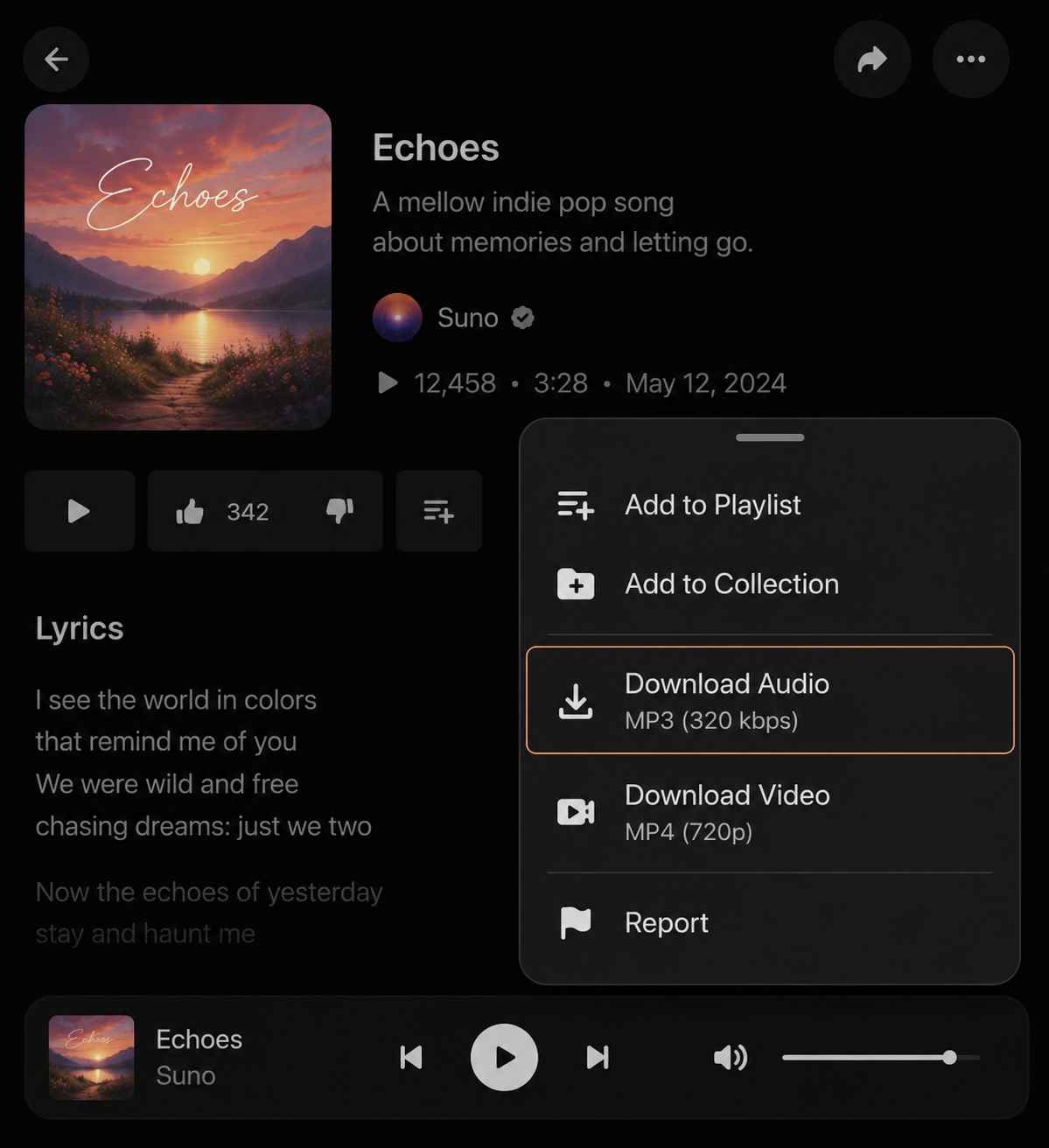
Download your song from Suno using the download options available to your account, then open BeatViz Workflow. Choose Studio Create · 2.0, upload the audio, and select the section you want to visualize.
Workflow 2.0 supports MP3, AAC, M4A, FLAC, and WAV files. It requires a local audio upload rather than a pasted Suno song link, and Studio Create · 2.0 is a paid-access feature.
If you want to create a full music video, make sure you've selected the intended song duration. A shorter selected range will produce a video for that range, not the entire original recording.
Step 2: Review Music Analysis and Build Your Storyboard
After music analysis, review the song's structure and available lyric captions.
Use your chosen concept to guide the video's overall story, visual style, and characters.
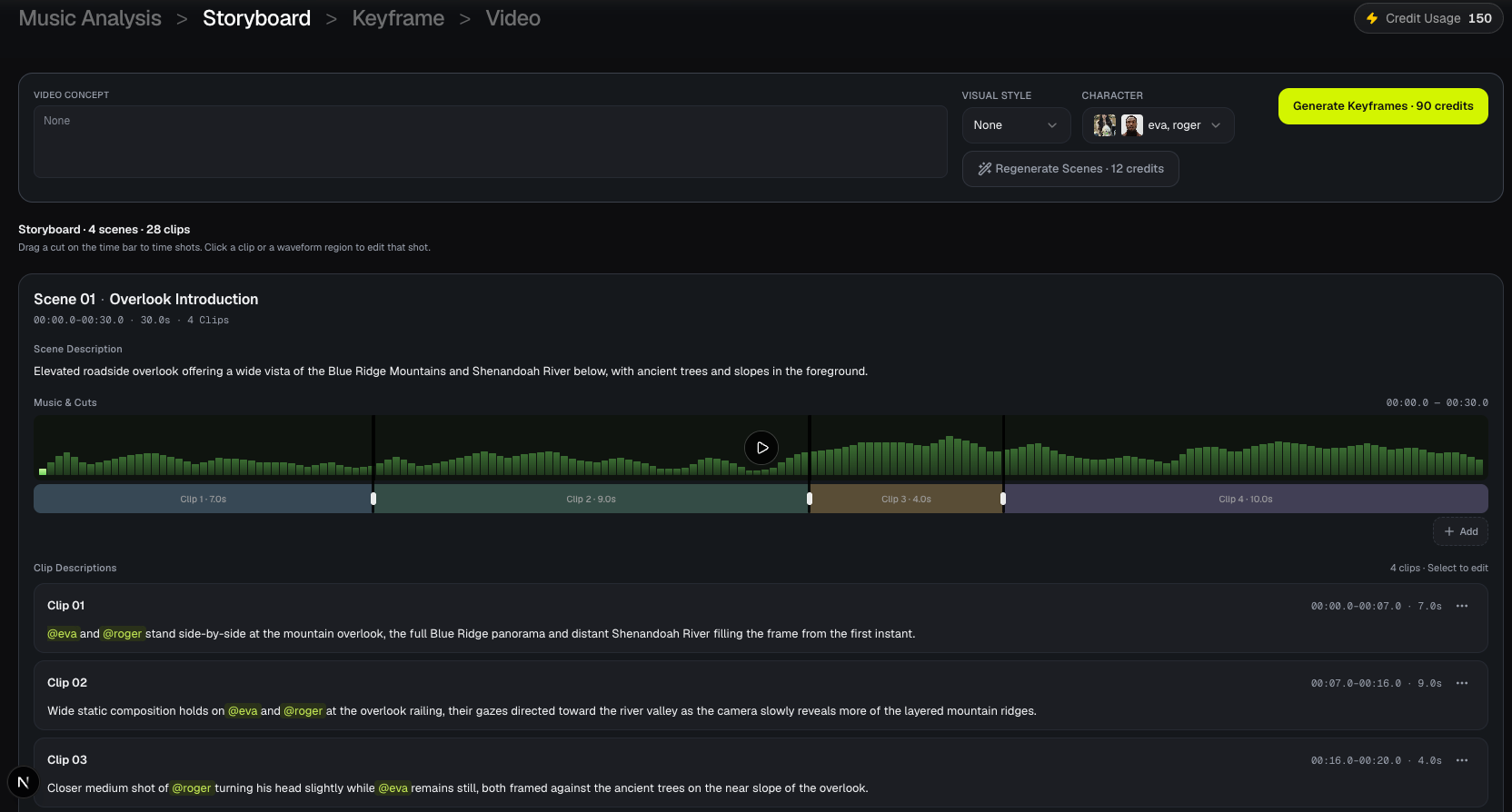
The Storyboard step then organizes the project into scenes and timed clips.
A scene represents a larger location or story beat, while each clip describes a specific shot within it.
For example, instead of a generic instruction such as:
A woman traveling on a train.
You could write:
The main character sits beside the train window, looking at the reflection of passing city lights. Slow lateral camera movement, intimate medium shot, natural expression, cool interior lighting, consistent charcoal coat and hairstyle.
You can refine clip descriptions and adjust cuts before moving forward.
You don't have to accept every automatically planned scene unchanged.
Step 3: Refine Keyframes and Choose Lip-Sync Clips
Once the storyboard is ready, generate opening keyframes for the planned clips.
These images help establish the appearance and composition of each shot before video generation.
Review the important visual details:
- •Is the main character recognizable?
- •Does the clothing match the story?
- •Does the background look correct?
- •Is the camera framing appropriate?
- •Are the face, hands, and body proportions natural?
Correcting an unsuitable opening image before generating motion can reduce unnecessary video retries.
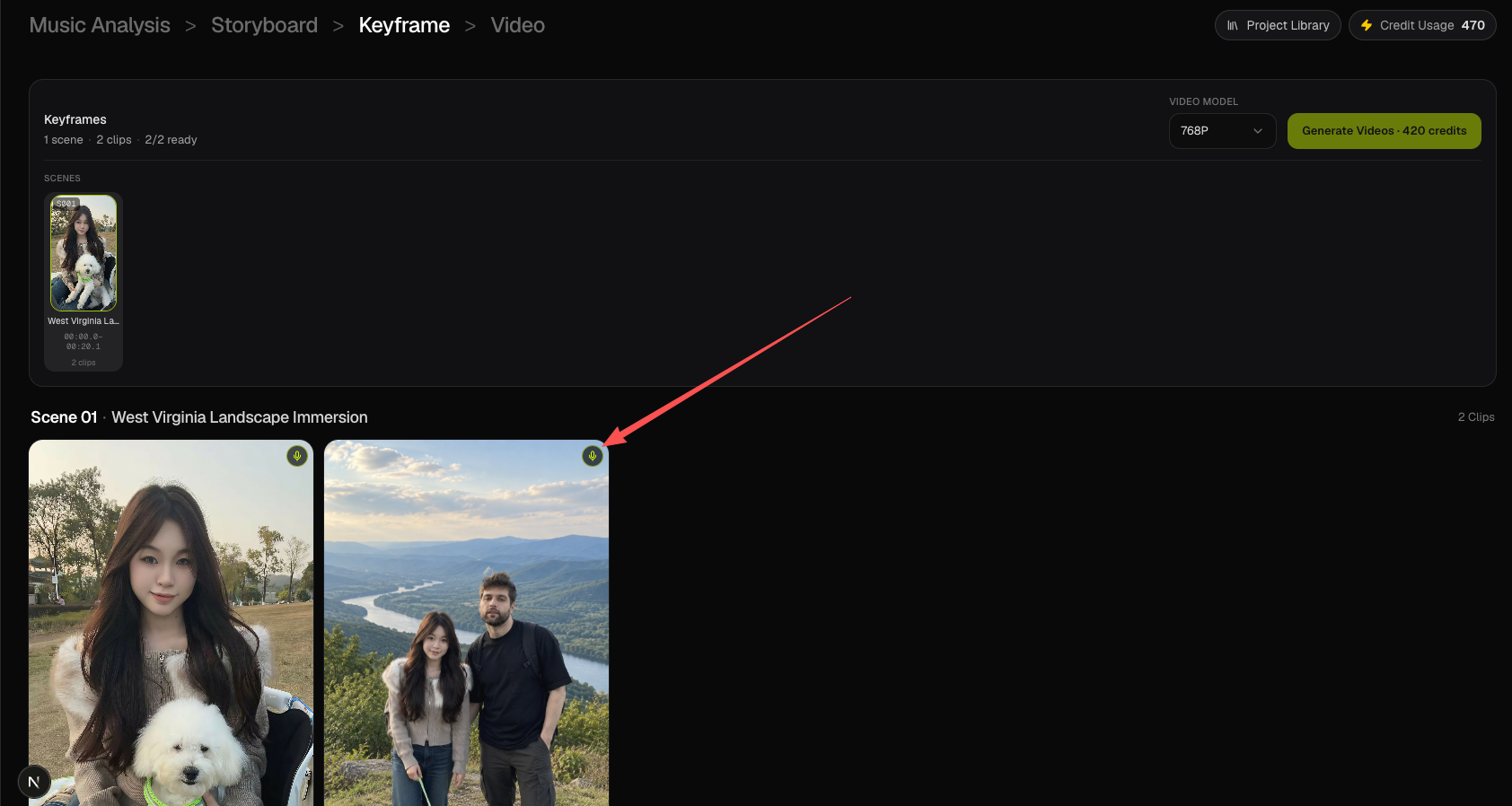
Workflow 2.0 also provides a per-clip lip-sync setting on the Keyframe step.
The microphone is enabled by default.
For a shot where the singer performs directly to the camera, leave it enabled so the video model receives that clip's trimmed audio along with the visual inputs.
For a wide environmental shot, instrumental scene, or a character who shouldn't be singing, turn it off.
This is a clip-level generation setting, not a separate lip-sync processing step applied after the video is finished.
Step 4: Generate, Review, and Export Your Music Video
After approving the keyframes, generate the video clips.
Review the results in the video workspace, paying particular attention to motion, character continuity, lip sync, and transitions between scenes.
If one shot doesn't work, revise the relevant description or keyframe and regenerate that section rather than unnecessarily replacing the whole project.
When all required clips are ready, export the composed music video.
BeatViz Workflow 2.0 uses the selected original song as the final soundtrack, helping keep the completed video's audio tied to the uploaded music.
Remember that music analysis, storyboard generation, keyframes, video generation, and export are separate stages with their own credit considerations. Review the estimated costs before generating a longer project.
Ready to turn one of these prompts into an actual video?
Upload your finished song to BeatViz Workflow and build your storyboard around the music.
BeatViz AI Director vs. Editor: Which Works Best for Your Prompt?
Different creators need different levels of control.
Some have a clear emotional direction but no idea how to divide it into scenes.
Others already know exactly which camera angle, character, and visual composition they want.
BeatViz offers different creation paths for those situations.
Use BeatViz AI Director When You Need Help Developing the Story
Suppose your starting concept is:
A nostalgic music video about someone revisiting the places they used to visit with their first love.
That's a strong emotional idea, but it isn't yet a complete shot list.
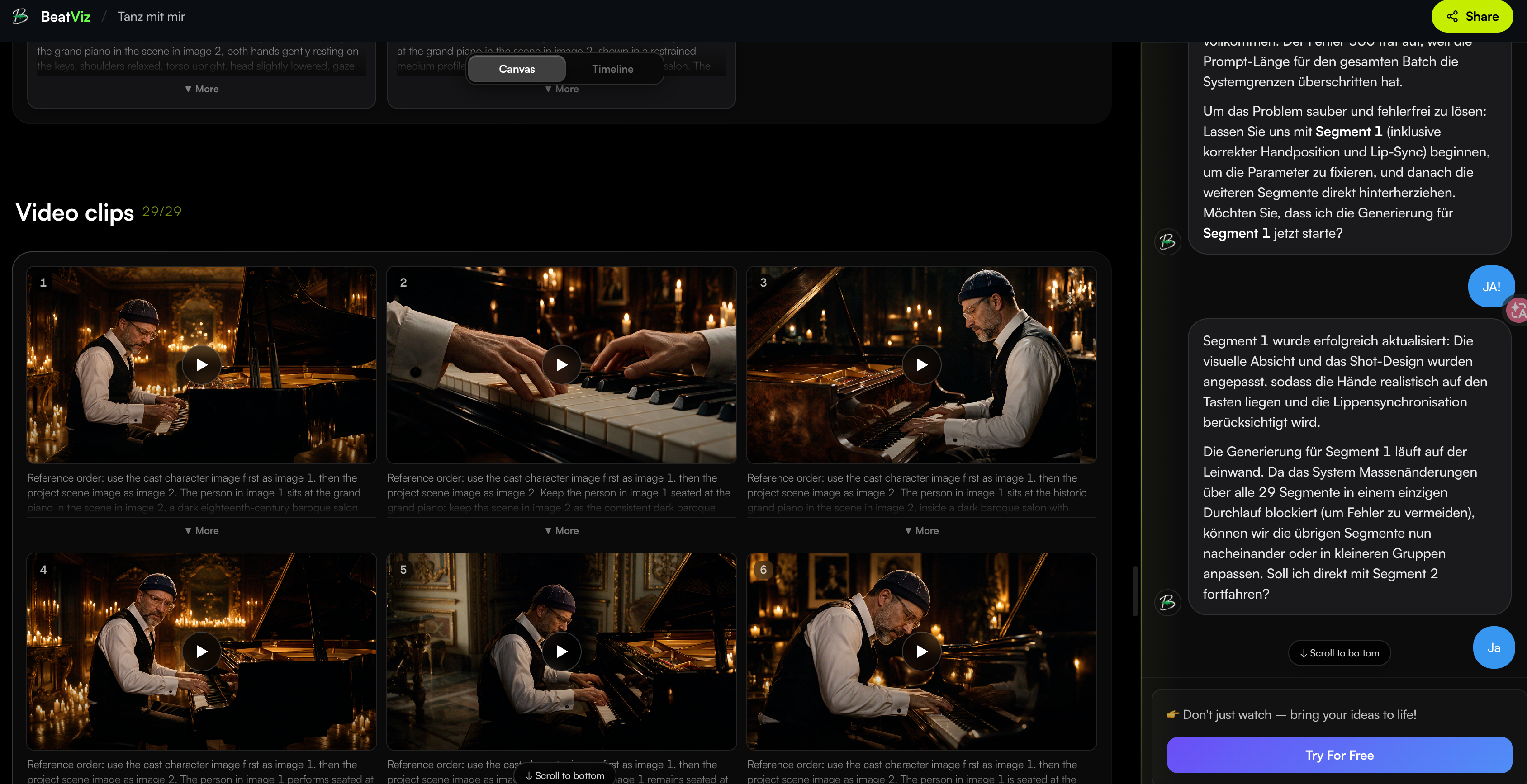
With BeatViz AI Director, you can develop the concept through conversation and guide the project through story and shot design.
For example, you might ask:
Make the first half feel like warm summer memories, but gradually reveal that the relationship has ended. Keep the same female protagonist throughout. Avoid excessive crying or melodramatic acting. Use realistic locations and an understated cinematic style.
You can refine the direction as you review the resulting creative work.
AI Director is particularly useful when you want help developing a consistent world before focusing on individual shots.
Use BeatViz Editor When You Want Precise Shot-Level Control
If you already know how every section should look, a manual editing environment may be more appropriate.
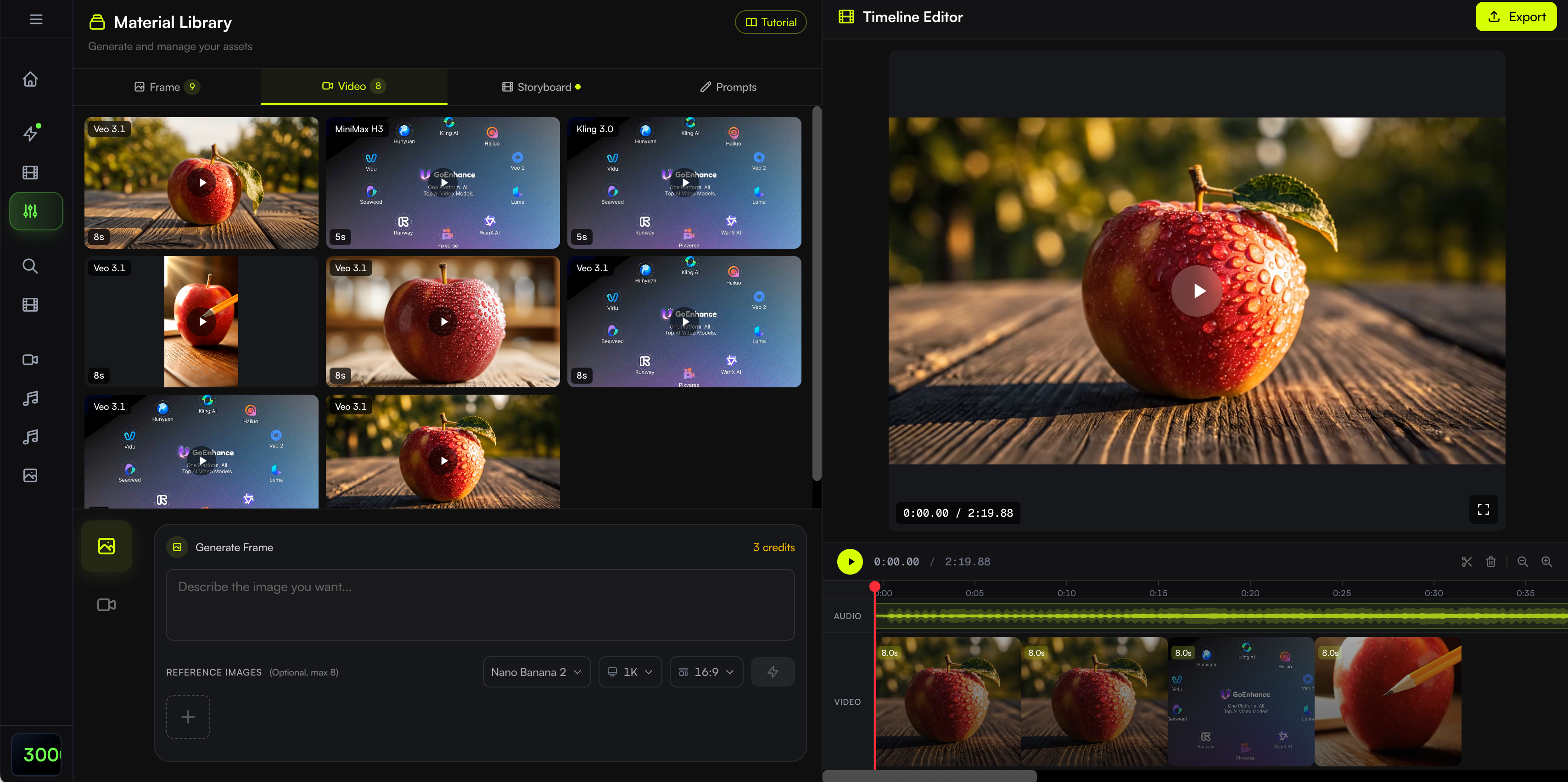
The BeatViz Editor lets you work with individual scenes, generated media, and a timeline.
This is useful when you want to:
- •Arrange specific video clips against your song.
- •Work with selected visual references or opening frames.
- •Refine individual shots without rebuilding the whole concept.
- •Review the relationship between the music and visual sequence.
- •Make detailed decisions about the final composition.
The Editor's Classic mode provides the timeline-based workflow. Its Chat creation mode offers a more conversational way to request images or videos for the asset library, but it is not the same as the complete AI Director workflow.
Choose a Creation Mode Based on Your Song and Budget
The best workflow depends on how much assistance you want and how precisely you need to control the result.
| Your Situation | Suggested Starting Point |
|---|---|
| You have a finished song and want a guided storyboard-to-video process | Workflow 2.0 |
| You have an idea but need help developing scenes and shot designs | AI Director |
| You already have specific shots in mind and want timeline control | Editor Classic |
| You want to create individual visual assets through conversation | Editor Chat |
Video-generation costs depend on the chosen workflow, model, duration, resolution, and any regenerated clips.
A practical approach is to test a short section of your song before committing to a full-length video.
You can review current plans and credit options on the BeatViz Pricing page.
7 Common Suno Music Video Prompt Mistakes to Avoid
Even a strong concept can produce disappointing results when the prompt or storyboard lacks clear direction.
Here are seven problems worth checking before generating your video.
1. Using Only Vague Visual Adjectives
Weak prompt:
Epic, beautiful, emotional, cinematic, professional music video.
These words describe a feeling but don't establish what should happen in the shot.
Better approach:
A solitary woman stands outside a closed train station at dawn. The camera slowly moves closer as pale sunlight reaches her face. Natural expression, restrained movement, realistic cinematic photography.
Give the model a subject, action, location, and camera direction.
2. Making Every Shot Look the Same
A video made entirely of similar medium shots can become repetitive, even when each clip looks good individually.
Use a mix of wide establishing shots, medium character shots, intimate details, performance close-ups, and environmental transitions.
The subject can remain consistent while the camera language changes.
3. Turning Every Lyric Into a Literal Image
If a song contains the line "I'm drowning in memories," you don't necessarily need to show a character underwater.
A more emotionally appropriate interpretation might be a person surrounded by old photographs or watching reflections in a rainy window.
Use the meaning behind the lyric, not just its literal objects.
4. Introducing Too Many Unrelated Locations
Moving between ten unrelated settings can make the video feel like a collection of AI demos.
Choose a smaller number of locations with recognizable details.
You can revisit the same environment under different lighting or from different angles to create progression without losing continuity.
5. Losing Character Consistency Between Clips
Changing the description of the protagonist in every prompt increases the risk of a drifting appearance.
Use a clear reference image and repeat only the necessary identifying details.
For a performance video, establish the singer's face, hair, costume, and stage environment before generating dozens of clips.
6. Making Characters Sing During Instrumental Sections
Lip sync is useful when a singer is visibly performing.
It becomes distracting when a character continues moving their mouth during an instrumental pause or appears to sing during a narrative scene.
Plan which shots actually need visible vocals.
When using a workflow with per-clip lip-sync controls, check those settings before generation.
For a deeper explanation of music video lip-sync workflows, read our guide to AI music video generators with lip sync.
7. Ignoring the Final Video Format
A beautiful 16:9 widescreen composition may not work as a 9:16 vertical video without reframing.
If you're creating a full music video for YouTube, horizontal framing may be a suitable starting point.
If you're designing a performance for Reels, TikTok, or Shorts, consider vertical composition from the beginning.
Leave enough space around faces, instruments, and important actions so your chosen framing doesn't cut away essential details.
Frequently Asked Questions About Suno Music Video Prompts
What is the best prompt for a Suno AI music video?
The best prompt depends on the genre, mood, and story of the finished song.
A useful starting structure is: Subject + Action + Location + Mood + Camera + Lighting + Visual Style + Constraints.
For a complete song, combine that visual prompt with a storyboard describing how the imagery changes between verses, choruses, instrumental sections, and the ending.
Can I use one prompt for an entire Suno song?
Yes, one high-level concept can guide an entire music video.
However, using exactly the same shot prompt repeatedly usually produces a less interesting result.
A stronger method is to maintain one consistent visual concept while creating different shot descriptions for the song's major sections.
For example, the same singer might appear in an apartment during the verse, perform on a rooftop during the chorus, and walk through the city during the instrumental bridge.
How do I keep the same character throughout a Suno music video?
Start with a clear reference image showing the character's face and appearance.
Keep important attributes consistent across prompts, including hairstyle, facial structure, wardrobe, and visual style.
Review opening frames before generating motion, and avoid unnecessary changes in character descriptions.
Character references can improve consistency, although AI video generation may still produce variations that require correction.
Can I make a music video from a Suno MP3?
Yes.
If you have a finished Suno song available for download, you can use the audio file in a compatible music video creation workflow.
For example, BeatViz accepts uploaded audio files and provides tools for planning scenes, generating visuals, and composing them against the song.
If you need a more detailed walkthrough, read How to Turn a Suno Song Into an AI Music Video.
Should every singing section use AI lip sync?
No.
A song can contain vocals even when the singer isn't visible on screen.
Use lip sync when the video clearly shows a character performing the lyrics. For scenes focused on storytelling, environments, or other actions, visible singing may be unnecessary.
A combination of performance, narrative, and instrumental visuals often makes a more engaging music video than continuous singing close-ups.
Can I create a music video for an instrumental Suno track?
Absolutely.
Instrumental tracks can work especially well with cinematic landscapes, abstract animation, dance, visual narratives, or atmospheric environments.
Focus on changes in rhythm, texture, energy, and emotional intensity instead of trying to represent lyrics.
Ideas such as The World Before Sunrise, Signals From Another World, and The Underground Techno Tunnel are particularly suitable for instrumental music.
Can I publish or monetize a music video made with a Suno song?
That depends on the rights associated with your music and any other assets in the video.
Suno's commercial-use permissions depend on the circumstances under which a song was created, including the applicable subscription terms. Commercial-use permission also does not automatically guarantee copyright protection.
Review Suno's current commercial-use guidance and make sure you have the necessary rights to any third-party lyrics, samples, voices, images, or footage before publishing or monetizing your project.
Turn Your Suno Song Into a Music Video Worth Watching
A finished song deserves more than a random collection of AI-generated clips.
The best music video ideas begin with a clear creative direction.
A rooftop performance can turn a pop song into a personal confession. A late-night train journey can give an emotional ballad a story. A paper-cut world can make an indie track feel entirely different from anything built with conventional cinematic footage.
The right concept doesn't have to be the most complicated one.
It simply needs to fit the music.
Start with one of these 25 Suno music video prompts. Adapt the characters, locations, mood, and camera direction to your song. Build a storyboard around the moments that matter, and refine the individual shots until they work together as a complete visual story.
You already have the music.
Now give it a world of its own.
Turn Your Suno Song Into a Music Video With BeatViz
Start in BeatViz Workflow. Or explore the BeatViz AI Music Video Generator to discover more ways to bring your finished music to life.